Queer Places:
Eton College, Windsor SL4 6DW, United Kingdom
University of Cambridge, 4 Mill Ln, Cambridge CB2 1RZ
Kilmeston Manor, Kilmeston Rd, Kilmeston, Alresford SO24 0NW, UK
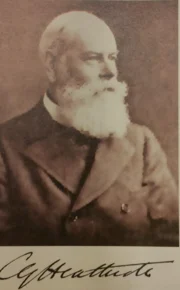 Charles Gilbert Heathcote (March 2, 1841 – November 15, 1913) was a Victorian landed gentleman, Cambridge scholar, barrister, stipendiary magistrate, avid alpinist, and
pioneering figure in the history of lawn tennis. As a co-founder of the All England Lawn Tennis and Croquet Club (AELTC) and a semi-finalist in the inaugural 1877 Wimbledon
Championships, he played a fundamental role in establishing modern tennis.
Charles Gilbert Heathcote (March 2, 1841 – November 15, 1913) was a Victorian landed gentleman, Cambridge scholar, barrister, stipendiary magistrate, avid alpinist, and
pioneering figure in the history of lawn tennis. As a co-founder of the All England Lawn Tennis and Croquet Club (AELTC) and a semi-finalist in the inaugural 1877 Wimbledon
Championships, he played a fundamental role in establishing modern tennis.
Born into an influential landed family at Conington Castle in Huntingdonshire (demolished in 1956), Charles Gilbert was the third son of John Moyer Heathcote. He received an elite classical
education at Eton College before matriculating at Trinity College, Cambridge in April 1859.
In 1862, he was elected a Scholar of Trinity College. He completed his Bachelor of Arts (BA) in 1863, achieving the high distinction of 9th Classic in the university's
rigorous Classical Tripos examination.
On 20 June 1863, he migrated to Emmanuel College, Cambridge, where he was elected a Fellow and subsequently appointed as a College Tutor. He completed his Master of Arts
(MA) in 1866.
During his Cambridge years, Heathcote was elected to the secret intellectual society known as the Cambridge Apostles.
Established as an elite forum for philosophical debate and literary discussion, the Apostles comprised Cambridge's most gifted minds.
Throughout the 19th and early 20th centuries, the Apostles played a central role in British socio-intellectual history, serving as an early nexus for homosocial intimacy
and romantic male friendships that challenged rigid Victorian norms regarding sexuality, aesthetics, and gender. Heathcote’s election placed him within this intimate network
of progressive Cambridge intellectuals.
Following his academic tenure at Emmanuel College, Heathcote transitioned to a distinguished career in the legal profession:
Admitted to the Inner Temple in January 1865 and formally called to the Bar on 18 November 1867. He practiced on the South Eastern Circuit.
From 1884 to 1902, he served as the Stipendiary Magistrate for Brighton, Sussex, handling local judicial administration and court trials.
In 1902, he acquired Kilmeston Manor near Alresford, Hampshire. He was appointed a Justice of the Peace (J.P.) for Hampshire in 1906.
Heathcote was one of the key gentlemen instrumental in creating the modern infrastructure of lawn tennis:
He was one of the founding members of the All England Lawn Tennis and Croquet Club.
He played in the inaugural 1877 Wimbledon Championships, advancing to the Men's Singles semi-finals before losing to eventual champion Spencer Gore. He subsequently lost
the 3rd-place play-off to William Cecil Marshall. Tennis historian Karoly Mazak retrospectively ranked Heathcote as the World No. 3 player for 1877.
He remained a prominent competitor, reaching the quarter-finals in 1878 and 1879, and making his final tournament appearance in 1880.
Alongside his brother, John Moyer Heathcote (a real tennis champion representing the Marylebone Cricket Club), Charles contributed to the committee that formulated the
early Laws of Lawn Tennis in 1877. In later years, he served as a judge and umpire at Wimbledon.
In addition to tennis, Heathcote was an accomplished mountaineer and a member of the elite Alpine Club, participating in Victorian mountain climbing expeditions in the
Alps.
On 9 September 1869, Heathcote married Lucy Edith Wrottesley (1848–1918), daughter of the Hon. Walter Wrottesley, at St James's, Westminster. They had three children:
Walter John Heathcote (1870–1936), who served as a British Consul in Turkey. Isabel Lucy Heathcote (1872–1961), who married Major Harry Broke in 1910. Francis Cooke Mark
Heathcote (1875–1953).
Charles Gilbert Heathcote died at Kilmeston Manor on 15 November 1913 at the age of 72.
References:
Other references:
- Tennis Archives / Player Search: Nieuwland, Alex (2011–2022), search by name for Charles Gilbert Heathcote (Tennis Archives, Netherlands). Available online at: [https://www.tennisarchives.com/player/Charles](https://www.tennisarchives.com/player/Charles) Gilbert Heathcote
- Tennis History & Rankings: Mazak, Karoly (2017), The Concise History of Tennis: Karoly Mazak World Rankings for 1877, p. 5 (ISBN: 978-1549746475).
- Biographical, Legal, and Institutional Compendiums: Eton School List , Inns of Court, Law Lists, Foster, Joseph, Men at the Bar , Peace, J.B. , Alpine Club Register , Burke, Bernard, Landable Gentry (L.G.) and Peerage and Baronetage (P. and B.)
Support this project
This website is a passion project researched, developed, and funded entirely by me. If you find the content valuable and would like to help support the ongoing research and hosting costs, any contribution is deeply appreciated.
Thank you for keeping this independent resource alive!
My books on Amazon: Elisa Rolle's books
BACK TO HOME PAGE
